The increasing use of artificial intelligence has brought both opportunity and risk to the legal profession. There is no serious dispute that AI can be a valuable time-saving tool. Used properly, it allows attorneys to spend less time on rote drafting and more time on analysis, strategy, and client counseling. In that sense, AI can enhance—rather than diminish—good lawyering.
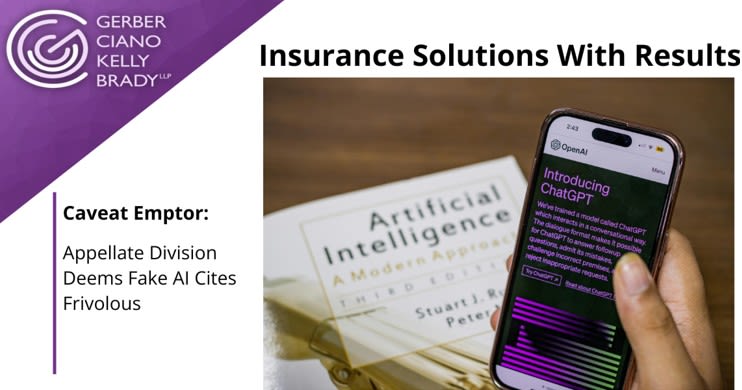
At the same time, courts are paying close attention to how AI is being used in legal filings. We have now seen multiple instances where briefs and motions included case citations that simply did not exist, or quotations that were attributed to real cases but never appeared in them. Courts are responding, and the consequences have not been uniform. Some courts have imposed monetary sanctions. Others have gone further, requiring attorneys to notify clients and other courts of their misconduct. What has been consistent, however, is the message: blaming AI is not a defense.
That message was made explicit in a recent decision from the Appellate Division, Third Department. Until other departments weigh in, the ruling applies to all New York trial courts. The court held, in no uncertain terms, that submitting hallucinated cases and fabricated quotations constitutes frivolous, sanctionable conduct.
In Deutsche Bank National Trust Company v. LeTennier, the defendant submitted at least 23 fabricated legal authorities across five filings during the pendency of the appeal. He also misrepresented the holdings of several real cases, claiming they were dispositive in his favor when they were not. The court had little difficulty concluding that sanctions were warranted.
In determining the appropriate sanction, the court emphasized that sanctions are not merely punitive. They are also “goal oriented,” intended to deter future frivolous conduct—not only by the offending party, but by the bar at large. Courts across the country, the Third Department noted, have imposed penalties ranging from warnings to sanctions in the tens of thousands of dollars for attorneys who submit AI-generated hallucinations and false propositions of law.
The court wrote:
“Accordingly, recognizing this as the first appellate-level case in New York addressing sanctions for the misuse of GenAI, we find the imposition of a monetary sanction on defense counsel . . . to be appropriate under the circumstances, with the further goal of deterring future frivolous conduct by defendant and the bar at large.”
Equally important was what the court did not say. The Appellate Division was clear that attorneys are not prohibited from using generative AI to assist in the preparation of court submissions. The problem arises when lawyers and staff are insufficiently trained on the technology’s limitations and rely on it without meaningful human oversight.
As the court explained, the use of GenAI is no different from relying on work produced by a paralegal, intern, or junior attorney. It does not abrogate an attorney’s obligation to verify every citation, quotation, and factual assertion before filing a document with the court. Failure to do so may be sanctionable, depending on the facts and circumstances of the case.
The takeaway is straightforward. AI can be a powerful tool in legal practice, but it is not a substitute for professional judgment. The duty to fact-check, cite-check, and ensure accuracy remains exactly where it has always been—with the attorney whose name appears on the filing.
Gerber Ciano Kelly Brady will always keep you advised of the latest court rulings. Contact Thomas Bona at tbona@gerberciano.com or Michael F. Harris at mharris@gerberciano.com.