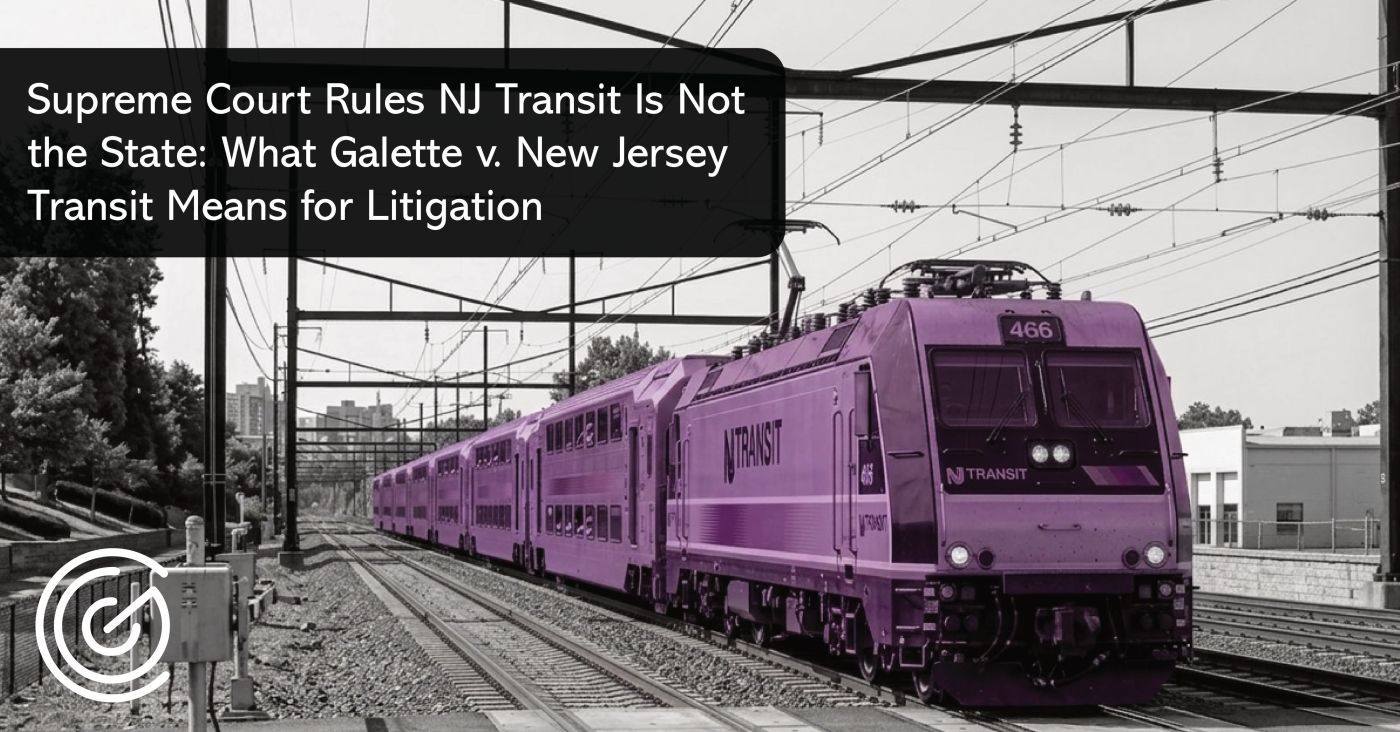
On March 5, 2026, the United States Supreme Court issued a unanimous and consequential ruling in Galette v. New Jersey Transit, holding that New Jersey Transit is not an "arm of the state" and therefore cannot claim sovereign immunity to block lawsuits brought against it in federal court. The decision, authored by Justice Sonia Sotomayor, has sent ripples through the legal communities — and its implications extend well beyond New Jersey.
What the Court Decided
The Court held that sovereign immunity is "personal to the state" and does not automatically extend to legally independent entities the state creates. The key question, the Court clarified, is whether the entity is genuinely separate from the state — not simply whether it was created by the state or performs a public function.
In NJ Transit's case, the Court pointed to two decisive facts: New Jersey is not formally liable for any of NJ Transit's debts or liabilities, and NJ Transit operates independently of state supervision. Those structural features, the Court held, disqualify it from claiming state immunity.
As Justice Sotomayor wrote, "States maintain the power to structure themselves as they wish and are free to amend their laws if they intend corporate entities to remain part of the state and for the state to assume their liabilities."
For a full breakdown of the decision and expert commentary, see the original Law360 reporting: Experts See Immunity Defense Reset After NJ Transit Ruling, Law360, March 6, 2026.
Implications for Litigation: A Changing Landscape
The Plaintiffs' Bar Has a New Roadmap
The Supreme Court's ruling hands plaintiffs' attorneys a powerful new framework for attacking immunity arguments. The Court's analysis — focusing on legal separateness, financial independence, and state control — gives litigants a structured approach to challenge immunity claims asserted by a wide range of public authorities. Cases that previously would have been dismissed on threshold immunity grounds will now have a much clearer path forward.
Expect a Wave of Challenges to Quasi-Public Entity Immunity
The ruling does not apply only to NJ Transit. Any state-created entity that holds itself out as immune from suit should now expect to have that status challenged under the Galette framework. This includes transportation authorities, housing agencies, public universities, water and sewer authorities, and similar entities nationwide. Defense counsel should audit their clients' structures now, before litigation forces the issue.
The Muhammad Decision Is in the Crosshairs
New Jersey litigants are widely expected to use Galette to attack the New Jersey Supreme Court's 2003 decision in Muhammad v. New Jersey Transit, which held that NJ Transit was a public entity protected by the Tort Claims Act. If that precedent falls — even partially — the litigation landscape in New Jersey will shift dramatically, with more cases proceeding to trial and higher exposure for NJ Transit and its insurers.
Defense Strategy Must Evolve
Defense attorneys can no longer treat sovereign immunity as a threshold motion that ends the case. The Galette framework requires a factual and structural analysis — not just a recitation of the entity's public mission. Defense teams will need to engage earlier, dig into governance documents and state statutes, and build a more sophisticated record to preserve immunity arguments.
What States and Public Entities Should Do Now
The Court's ruling includes an implicit directive to state legislatures and public entity boards: if you want immunity, structure your entities to earn it. That means formal state assumption of liability, genuine state control, and statutory language that ties the entity's debts to the state itself.
For entities that currently lack those features, the window to restructure — or at least to conduct a thorough legal audit — is now. Waiting for litigation to force the question is a costly strategy.
The Bottom Line
Galette v. New Jersey Transit is a landmark decision that reframes how courts, litigants, and public entities think about sovereign immunity. The unanimous opinion brings long-needed clarity to a fractured area of law, but that clarity cuts both ways: it gives plaintiffs powerful new tools while stripping away automatic immunity defenses that public entities have relied on for decades.
The status quo, as mentioned in Law360's reporting, "was completely disrupted."
For more information, contact Patrick J. Reilly III.